Student WorkProduct Design · 2025

Backstage

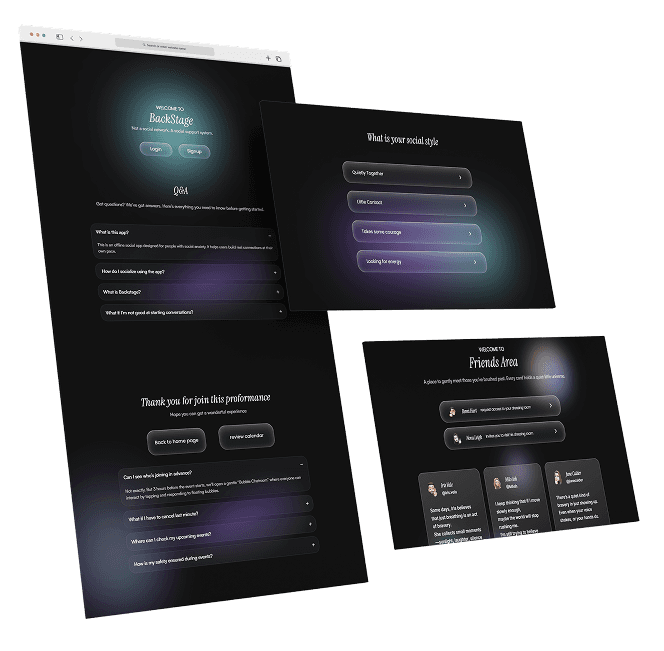
Backstage running in a browser: the landing page with its FAQ, the social style chooser, and the friends area

A consumer product that gets people to real-world events without asking them to host, browse, or be chosen.

The problem
Every offline-social app asks you to make the first move before anything happens.
What I did
User research, product direction, UX, UI, and an interactive prototype.
The outcome
An invitation-led experience built and revised across two rounds of testing.
Role
Product Designer
Scope
Research · UX · UI
Platform
Web
Timeline
12 weeks

Problem

Meeting people offline still depends on being the one who starts it.

People spend more time on social platforms and still report fewer real-world plans. The apps meant to bridge that gap all begin with an act of initiative - posting an event, joining a large group, or presenting yourself to be picked.

How often do you proactively meet new people?

Single choice · 28 responses

14.3%
Every week
7.1%
Every month
39.3%
Occasionally
35.7%
Rarely
3.6%
Never

Nearly four in five meet new people occasionally at best. Four of the twenty-eight do it weekly.

What worries you most about meeting someone in person?

Single choice

No common topics, or it turns awkward
46.4%
Safety
32.1%
The time it takes
14.3%
Finding out it is not a good match
7.1%

What would make you willing to meet strangers?

Multiple choice

A shared interest
78.6%
A safe public place
71.4%
A friend vouches for them
35.7%
Only at a specific event
17.9%
I would not meet strangers
3.6%

The barrier is not desire, it is the opening move: awkwardness outranks safety as the top worry, while a shared interest and a public place are what most people said would get them to say yes.

Design Highlights

Four moments carry the product.

Declaring a mode, receiving an invitation, keeping a private room, and recording what happened - each one is designed so the user never has to be the first to speak.

01 / Onboarding

Set the mode you are actually in

Onboarding asks two things: when you are free, and what kind of company you want - quietly together, little contact, takes some courage, or looking for energy. There is no profile to fill in and no bio to write.

02 / The invitation

One event at a time, and you can pass

An invitation names the event, time, place, and the seats left. Join it, or change it and a different one takes its place - no reason asked for. Confirming ends on the questions people actually have, safety included.

03 / Your own room

A private space others have to be let into

The dressing room holds your diary, your settings, and your permissions. People send a request to visit; unlocked areas are the ones you opened yourself.

04 / After the event

Keep the evening without having to post it

The diary saves what you went to as photo cards with the people who were there. Whether any of it is visible to others is a separate decision, made afterwards.

Research Insights

Three findings set the product direction.

A survey, follow-up interviews, and a review of four existing platforms pointed at the same gap: people wanted a way in that did not require them to go first.

Insight 01

People wanted structure, not more choice

Both personas asked for the same thing from opposite situations: a newcomer who prefers structured activities, and a remote worker who wants a structured way to meet people but finds planned groups stiff. Neither wanted a longer list to browse.

78.6% would meet strangers for a shared interest; 71.4% need a public place

Insight 02

Only offline contact counted as friendship

One interviewee, 27 and working in education, said she considers only people she meets in person real friends - everyone else is a “digital neighbour.” Being online more had not produced the relationships people wanted.

78.6% have found online chats easy but the meeting awkward

Insight 03

Existing platforms put the first move on the user

Partiful assumes you will host or organise. Meetup runs on large gatherings. Eatwith splits people into host and guest. Dating apps lead with looks. Each one asks the user to step forward before anything happens.

Competitive review of four offline-social platforms

Li Wei

22 · International student · Jersey City

Prefers structured social activities

  • Isolated after moving to a new city
  • Finds it hard to make friends outside of school
  • Language barriers make unstructured settings harder

Alex

35 · Software engineer · Astoria, Queens

Wants a structured way to meet like-minded people

  • Frustrated by superficial online relationships
  • Struggles to find engaging offline events
  • Finds planned group activities lack spontaneity

A small student study - 55 people in total, none counted twice: 28 survey responses, then a handful of interviews and two rounds of usability testing. Directional, not representative.
Product Direction

Not a social network. A social support system.

The name comes from Goffman’s idea of a front stage people perform on and a backstage they prepare in. The product is built around the second one: a place you can be in before you are ready to be seen.

Declare, don't perform

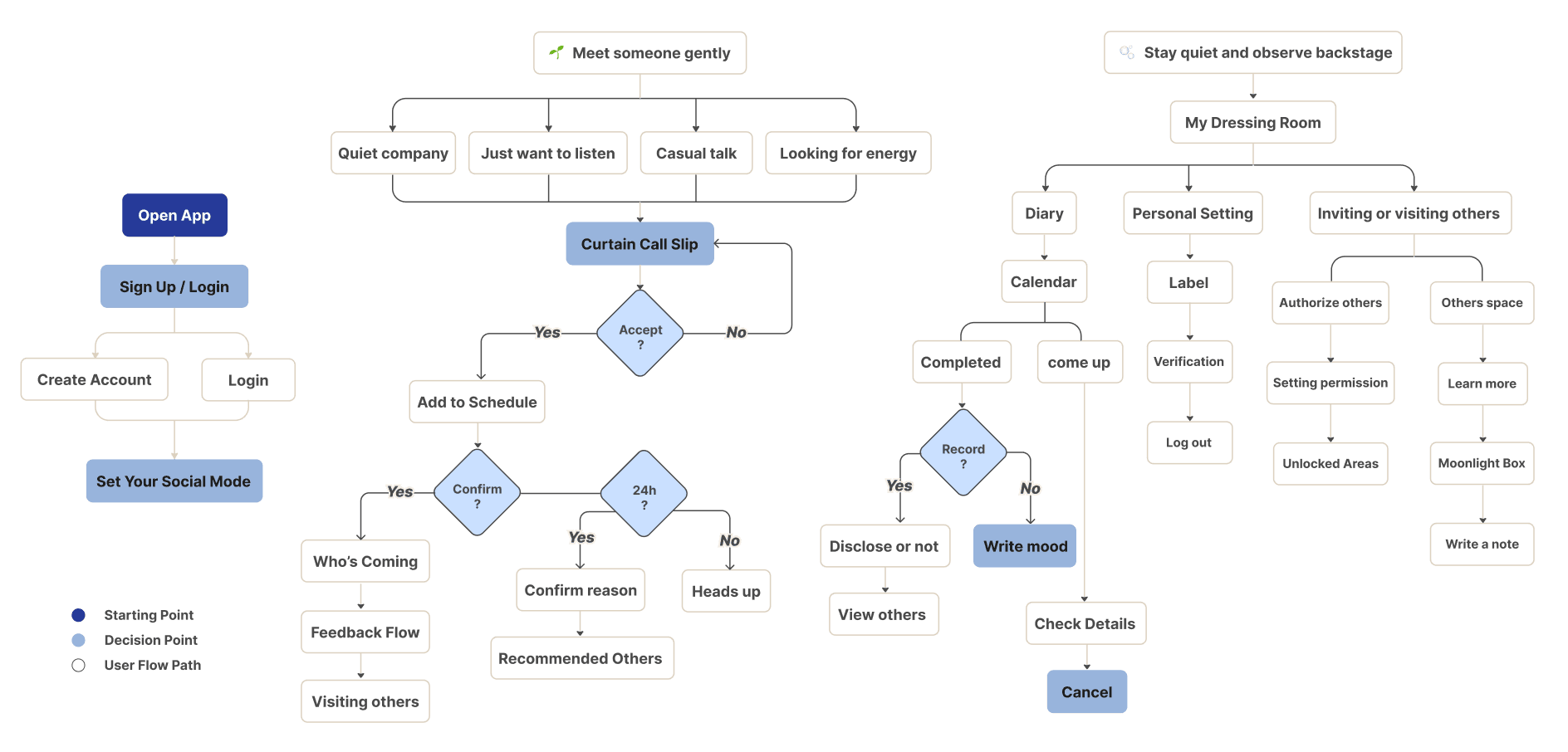
Before browsing anything, you set a social mode - quiet company, just want to listen, casual talk, or looking for energy. The app matches the energy you actually have today.

Be invited, not matched

The platform sends a single invitation to a small event. There is no mutual selection, no swiping, and no profile to win over.

Passing costs nothing

Declining returns a new invitation instead of a penalty or an empty feed. Saying no is a normal move, not a failure state.

Keep a private room

The dressing room is yours by default. Others need permission to enter, so visibility is something you grant rather than something you lose.

The four modes, in the order the product offers them

  1. Quietly together
  2. Little contact
  3. Takes some courage
  4. Looking for energy
Barely any contactActively wants company

What each one asks of you first

Meetup
Walk into a gathering of a hundred strangers
Partiful
Host it yourself, or already know the host
Eatwith
Be a guest at someone else's table
Tinder / Bumble
Be picked, on looks, before you ever meet
Backstage
Accept an invitation, or pass without explaining
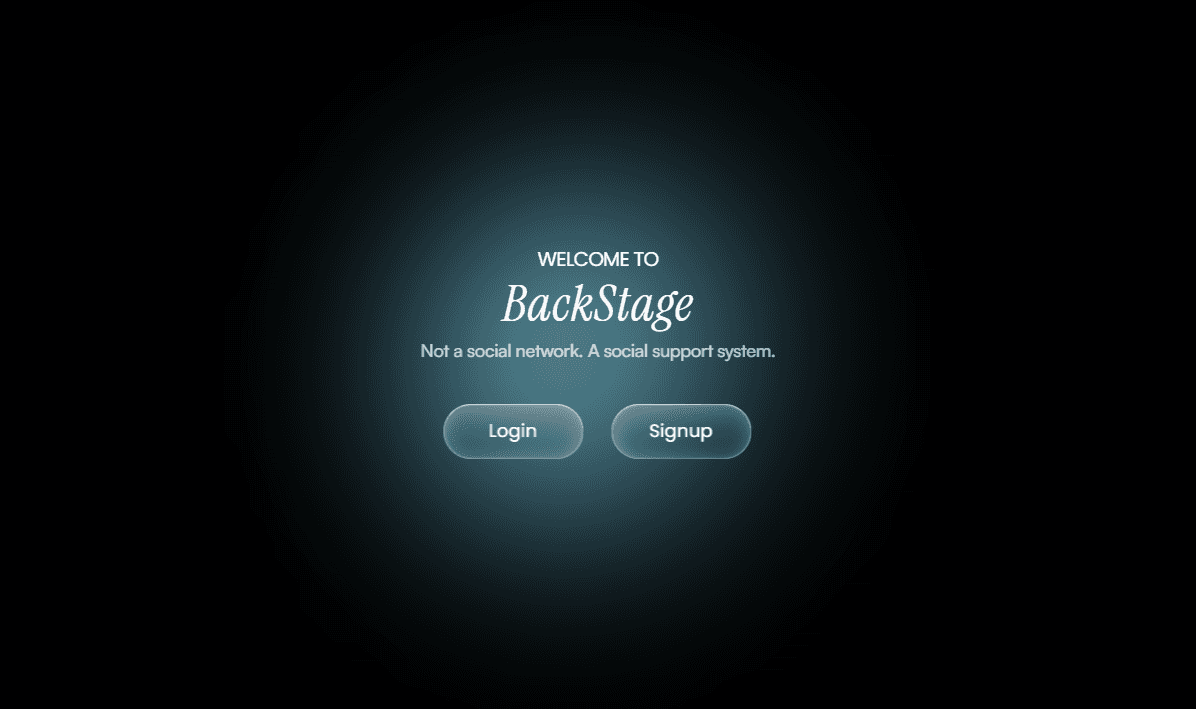
Backstage welcome screen reading: Not a social network. A social support system.

Iteration 01

The first version was a Meetup clone, and the review said so.

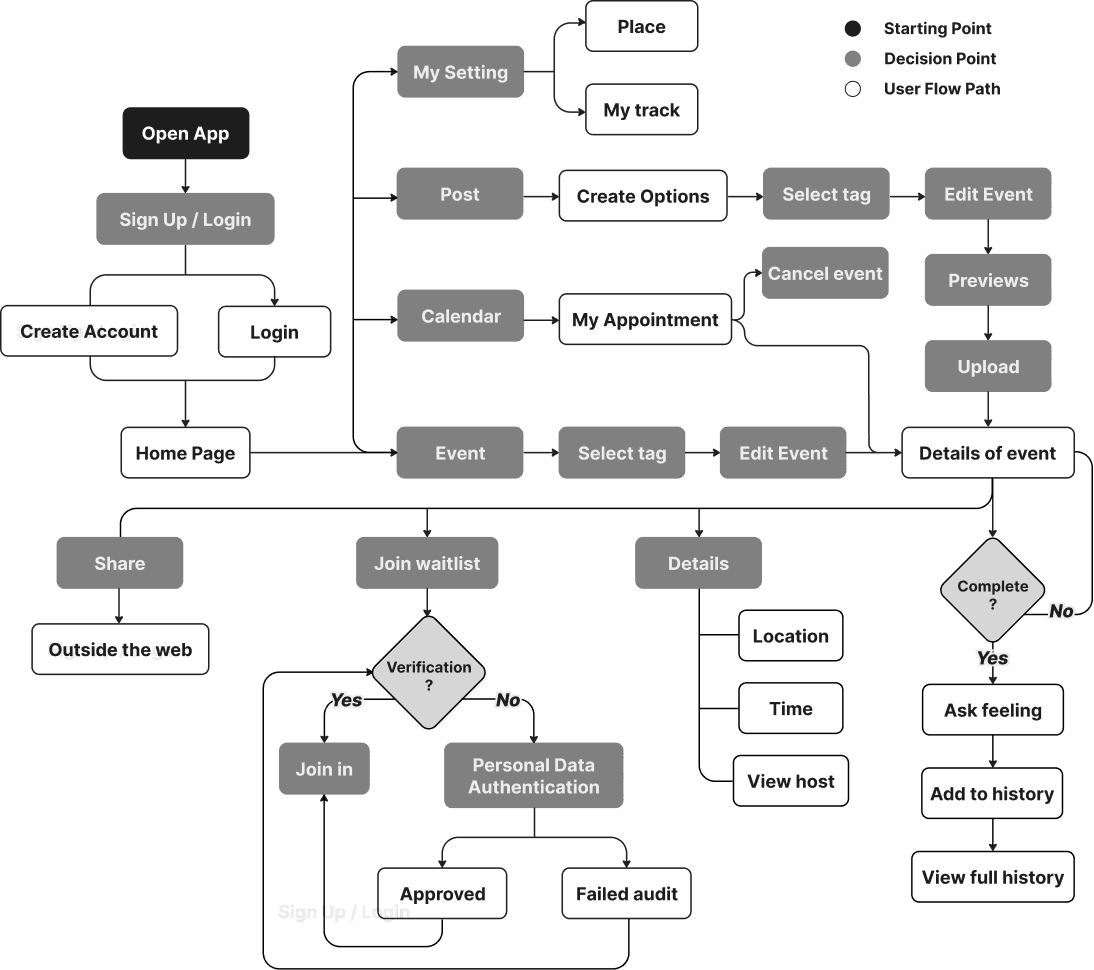
The first build let people post events, browse a filtered feed, and join a waitlist behind identity verification. It worked, and it was indistinguishable from what already existed.

Feedback

The midterm review was blunt: the concept was clear and the offline focus was right, but it was too close to Meetup to be worth choosing. Both reviewers pushed the same way - build around people, not around a catalogue of events.

Design change

I removed the ability to create or freely browse events. The platform now assigns the activity and the user picks from a few curated options instead of an open feed. Group size was capped small, around three to six, so a table stays conversational.

Result

The flow stopped being a marketplace and became one decision per invitation. The final build still shows the seats remaining - usually three.

Before — browse, post, join a waitlist
First user flow: home page leading to event browsing, posting an event, and joining a waitlist with personal data authentication
After — set a mode, accept or pass
Revised user flow: set your social mode, receive a curtain call slip, accept or decline, plus a private dressing room with permissions

Iteration 02

The second round was about language, safety, and weight.

With the direction settled, testing moved to whether people could read the product - what things were called, how exposed they felt, and how it made them feel before they had used it.

01

Feedback

“Upcoming Performances” was read as theatre shows rather than social events.

Design change

Renamed the event language across the product to plain terms - invitations, activities, calendar.

Result

The final screens use Invitation and Activities Participated.

02

Feedback

Testers were uneasy about safety and about how much of themselves would be exposed.

Design change

Made the dressing room permissioned - others request access, and you grant it - and answered the safety question directly in the product.

Result

The built product includes access requests, unlocked areas, and a safety question in the FAQ.

03

Feedback

The two calendars overlapped and testers were unsure which one they were looking at.

Design change

Merged them into one calendar that holds both what is scheduled and what has already happened.

Result

The final build carries a single year-and-month view.

04

Feedback

The dark theme read as too heavy and serious for something meant to feel welcoming.

Design change

Kept the dark base, but softened it with warm photography, diffuse glows, and lighter type instead of switching to a light theme.

Result

A partial change - I kept the atmosphere and treated weight as the thing to fix, not darkness itself.

Design System

Soft light on a dark ground.

A serif display face for anything addressed to the user, a plain sans for controls, and diffuse glows instead of hard edges - so a dark interface reads as quiet rather than severe.

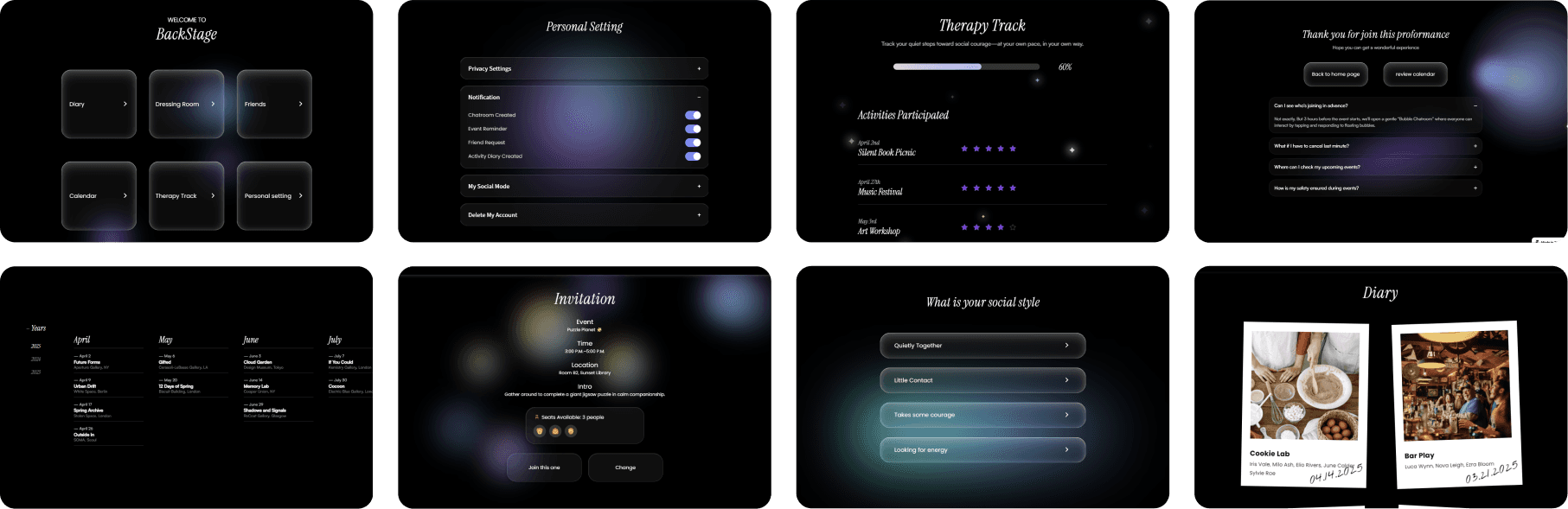
The language applied across the built pages
Backstage final screens: home, personal settings, activity track, calendar, invitation, social style, and diary
Typography
Backstage typography specimen
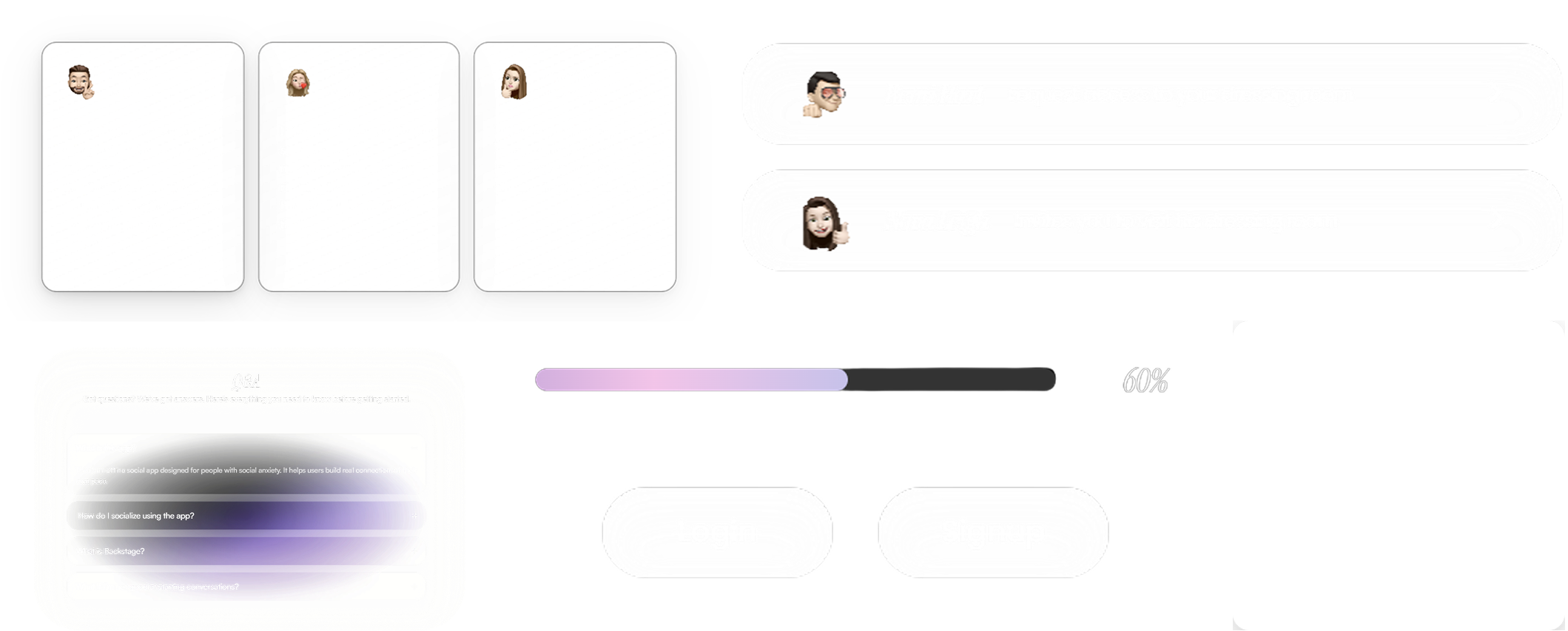
Components
Backstage component library: profile cards, access-request rows, FAQ accordion, progress bar, buttons, and calendar

Reflection

Removing choice is the idea and the risk.

The main tradeoff

Taking away choice is what makes the product work and also what limits it. A user who wants to pick a specific event on a specific night cannot, and I never tested how that feels over weeks rather than one session.

Limitations

This was a student project with a small survey, a few interviews, two rounds of qualitative testing, and no live events behind it. Nothing here has been validated against real attendance or safety incidents.

What I would test next

Whether people accept an invitation they did not choose, and how many times they pass before the invitation model starts to feel like it is not listening.